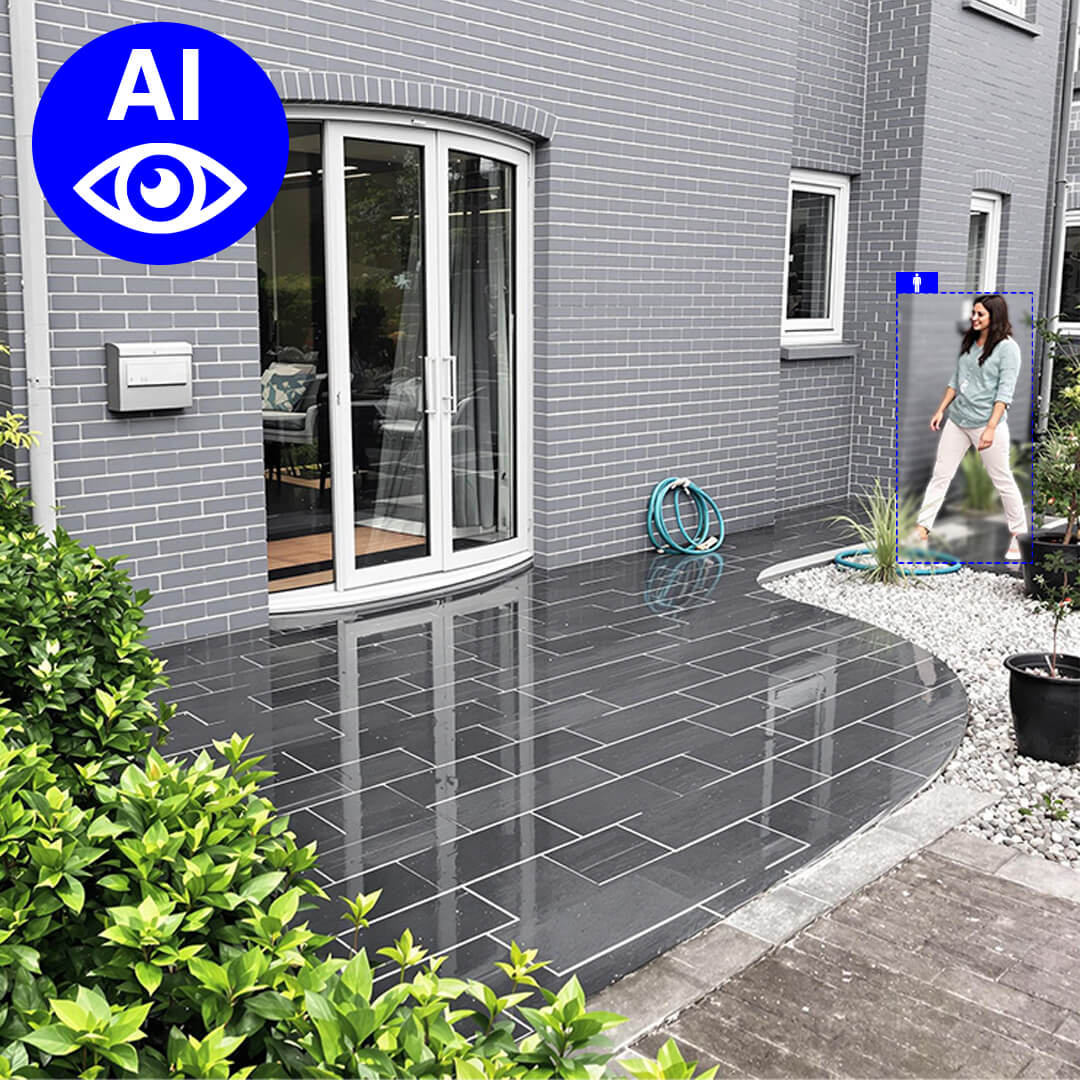
Intelligent recognition: AI-powered recognition of people and vehicles
Share
Intelligent, AI-powered detection is literally bringing a breath of fresh air to video surveillance. . Modern surveillance cameras can use machine learning and deep learning to automatically analyze video recordings for security-relevant events—especially whether a person or vehicle appears in the image . Unlike conventional motion detection, which raises an alarm at the slightest movement, AI can distinguish between important and unimportant movements. This leads to significantly fewer false alarms and more efficient monitoring. The technology has now matured to the point where it benefits not only companies but also private users and small businesses by bringing professional security features into everyday life.
How does AI recognition work? (Technically explained in simple terms)
AI recognition in modern cameras is based on computer vision technologies, primarily deep learning algorithms. Simply put, an artificial neural network learns to recognize certain objects—such as people and vehicles—in image data. A typical task of AI-based video analysis is the visual detection and differentiation of people and vehicles in a video stream. . The algorithm was trained with numerous sample data to internalize the visual features that characterize a person or a car In practice, this means that after training, the camera "knows" what people or vehicles normally look like and can recognize them in live video. Modern deep learning models are particularly powerful and reliable because they capture complex shapes and differences where simple, hard-coded algorithms reach their limits. .
Thanks to advanced hardware, many of these analyses can now be performed directly in the camera in real time. As soon as something moves in the field of view, the camera analyses the scene with its AI module: Is it a person, a vehicle or “just” a harmless object like an animal? Older systems often only worked with simple motion sensors or pixel comparisons – a branch blowing in the wind or a shadow passing by could trigger an alarm. AI-supported recognition, on the other hand, focuses on content : It recognises shapes and objects. If, for example, a person walks through the frame, the AI registers the typical human silhouette and classifies the object as a “person”. If a car drives away, it recognises the size, contour and movement as a “vehicle”. The software classifies anything that does not fit into the learned categories as irrelevant . This creates object differentiation : The camera reacts specifically to people and vehicles and largely ignores irrelevant triggers.
Everyday benefits – Fewer false alarms, targeted notifications, greater relevance
AI-powered object recognition offers noticeable advantages in the daily use of a surveillance camera, whether at home or in everyday business:
- Fewer false alarms: Because the camera only triggers when there are real people or vehicles, false alarms caused by wind, weather, or animals are drastically reduced. Motion detection with AI (person/vehicle detection) reliably prevents annoying false alarms. For users, this means fewer false alarms in the middle of the night and a security system that is more trustworthy.
- Targeted notifications: Instead of constantly being alerted by every movement, you receive notifications only for relevant events . For example, the camera software can be configured to send a notification when an unfamiliar car is detected on the property or a person approaches the front door – and ignore minor details. This intelligent filtering ensures that you are only notified in an emergency. The user can be confident that an alarm message actually indicates something important (such as a visitor or a possible intruder) and not just a stray cat in the garden.
- More relevance and focus: By filtering out unimportant triggers, the relevance and clarity of the recordings are increased. The AI consistently filters out insects fluttering by, falling leaves, or moving branches. What remains are mostly clips with actual activity from people or vehicles. This also makes it easier to review the video footage later: You can find the areas of real interest more quickly, instead of spending hours reviewing footage without any events. For private users, this means less time and stress, and for small businesses, it's a more efficient security process – you can focus on the truly relevant events.
In addition to these main advantages, many AI cameras offer additional convenient features: Some models, for example, allow you to define detection zones so that only specific areas are searched for motion. Integration with apps and smart home systems is also common, allowing you to receive notifications directly on your smartphone and react immediately in an emergency. Overall, AI cameras significantly increase the reliability of surveillance—an important factor in building trust in the technology.
Examples – AI in modern surveillance cameras
Today's surveillance cameras for residential and small business use already impressively demonstrate how AI detection works in practice. Models like the EZVIZ C8W Pro 2K, H8 Pro 2K, and H8 Pro 3K feature integrated AI algorithms and can reliably distinguish whether a detected movement is a person, a vehicle, or something else. . This built-in intelligence allows the cameras to avoid random alarms and filter out swirling leaves or insects flying past as unimportant. Instead, they focus on relevant objects : If the camera detects a person or a car, it is immediately classified as such and reported accordingly.
A practical example is automatic tracking : Movable pan-tilt (PTZ) cameras, such as the aforementioned EZVIZ H8 Pro 3K, automatically rotate toward a detected person and keep them in the frame. If, for example, a person walks through the monitored area, the camera automatically adjusts and tracks the movement, even zooming in up to 4x to capture details. This ensures the owner doesn't miss any important moment – the entire action is captured seamlessly, from the moment the camera first appears until it leaves the field of view. At the same time, the specified surveillance area remains covered: After tracking, the camera automatically returns to its starting position to ensure a full panoramic view.
Intelligent alarm functions are also enhanced by AI detection. Some models react not only passively, but actively: If an intruder is detected, for example, the camera can immediately trigger a siren or flash a light to deter the intruder – and only if a person is actually detected. The H8 Pro 3K, for example, also explicitly informs the user if a vehicle has been parked illegally on the property. Such AI-enabled features demonstrate that surveillance cameras today are much more than simple motion detectors: They understand the type of object and can react accordingly , depending on the situation .
Conclusion
AI-supported human and vehicle detection is now considered a game-changer for modern surveillance solutions. The combination of smart software and powerful camera technology makes security systems more reliable and user-friendly . False alarms caused by insignificant movements are largely a thing of the past – this creates trust because users can be sure that an alarm message actually has a reason. At the same time, convenience increases: You don't have to constantly monitor the camera images yourself, because the intelligent camera specifically reports relevant events.
This development opens up new possibilities, especially for private households and small businesses. What was once reserved for expensive professional systems can now be found in affordable, easy-to-install devices for the home or office. The barrier to using surveillance technology is lowering, as AI simplifies handling and increases efficiency . The bottom line is that this is sparking interest in modern surveillance solutions that can do more than just record: they can think for themselves . Intelligent detection transforms cameras from mere observers into active helpers that alert at the crucial moment – thus providing a sense of security, whether in your own home or in a small business.
Regarding the cameras mentioned: